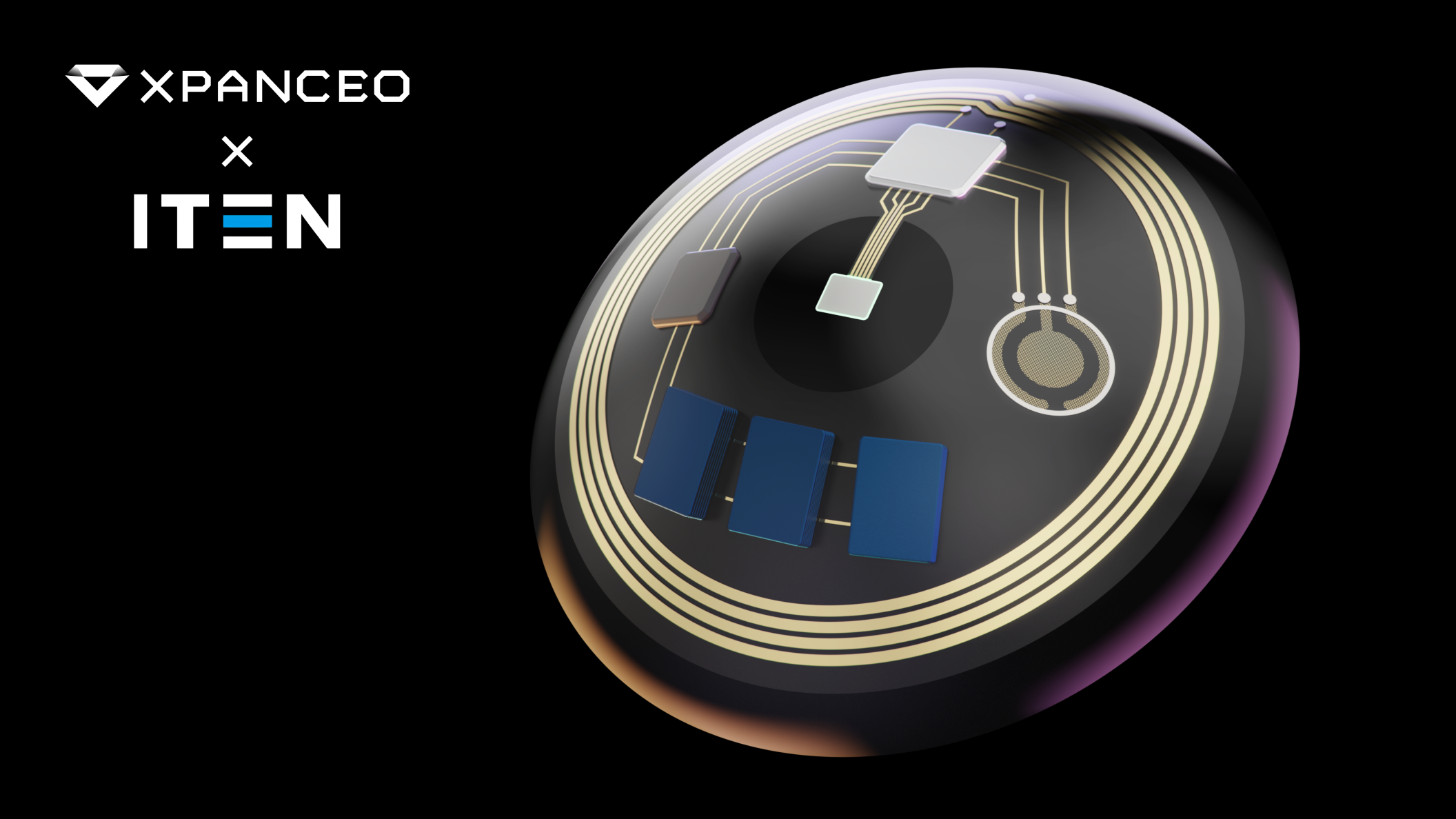
XPANCEO and ITEN Create Proof of Concept for Smart Lens with Integrated Solid-State Battery
Deep-tech pioneer and solid-state energy storage innovator demonstrate the first viable energy storage solution for smart contact lenses.
Lyon, France, and Dubai, UAE — XPANCEO, a deep-tech company pioneeringsmart contact lenses, and ITEN, a manufacturer of solid-state energy storagesolutions, have developed a proof of concept for integrating a microbattery into asmart contact lens. The collaboration solves a main challenge in ocular wearables:making energy storage ultra-thin, durable, and stable enough to be safely used indevices worn directly on the human eye.
XPANCEO is developing smart contact lenses with AR and health monitoringcapabilities as the ultimate computing platform for the AI era. Unlike AR glasses orVR headsets, a contact lens must deliver full functionality within a submillimetre-scale form factor and operate safely directly on the eye. This creates strictconstraints on thickness, mass, heat generation, and material selection, withbiocompatibility and user safety as critical requirements. Among other effects, theserestrictions create a fundamental power challenge.
A fully featured smart contact lens requires different power levels for different tasks.Wireless connectivity and ultra-low-power functions, such as biosensing, can besupported by energy-harvesting mechanisms that capture small amounts of energyfrom the wearer’s body and immediate environment — including mechanical energyfrom blinking, thermal differences across the lens, electrochemical reactions withtear fluid, and integrated solar cells. However, high-energy functions, such as imageprojection for AR, require sustained milliwatt-level power. This makes high-densityenergy storage essential for full functionality.
In some ways, powering a smart contact lens is more difficult than poweringimplantable devices such as pacemakers. Implantable medical devices operate atvery low power and typically use high-density lithium batteries, both non-rechargeable (primary) and rechargeable, enclosed in rigid, sealed housings usuallymade of titanium. In some long-lived implants, nuclear batteries have been used. Acontact lens has no space for such shielding or rigid enclosures, making differentsafety and power approaches necessary.
Most existing energy-storage solutions are too bulky and volatile to be safelyintegrated into a soft, curved, ultra-thin contact lens. Lithium-ion cells can swell, leak,or overheat, making them unsafe for direct contact with the eye. Liquid-electrolytebatteries also carry risks of leakage or explosion if they fail. Even during normaloperation, such batteries can release small amounts of hydrogen and can slightlyexpand in volume, particularly during initial cycles.
Solid-state batteries offer a promising solution since because they cannot leak, swell,or explode. If a failure occurs, the system simply stops supplying power. ITENsolutions can be engineered in ultra-thin, flexible formats compatible with softcontact-lens substrates, while still providing high enough power density for the shortbursts of energy required by AR displays and wireless connectivity, without rapiddegradation.
ITEN uses its specialized expertise in nanomaterial fabrication to produce fullyceramic electrodes with a patented mesoporous structure — meaning the materialcontains a network of extremely small, controlled pores. This structure significantlyincreases the electrode's surface area, so the device can deliver higher power andcharge and discharge more efficiently. Since May 2025, ITEN has been mass-producing the first generation of solid-state ceramic microbatteries that offer anunrivaled mix of power density, recharge speed, safety, and reliability. Thistechnology is employed to develop a customized microbattery specifically designedto meet the smart-lens specifications of XPANCEO.
During the first stage of the ITEN–XPANCEO collaboration, engineers solved criticalintegration challenges involving the design of a multi-stage encapsulation process.They developed a dedicated energy harvester for optimal operation with dynamicallychanging wireless links. They also examined critical thermal and overvoltageconsiderations relevant to battery operation in the electromagnetically andmechanically dense environment of a contact lens.
Solid-state energy storage is still in the early stages of adoption, with a limitednumber of companies that are capable of producing miniature and high-efficiencycells in high volume. The ITEN–XPANCEO proof of concept demonstrates that high-power-density energy storage can now be manufactured in volume production andsafely integrated into a contact lens, marking a crucial milestone in making smartcontact lenses commercially viable.
“The power system is the real bottleneck in smart contact lens development — andit’s not something you fix with small tweaks. We needed a whole new approach toenergy storage at the micro-scale. Working with ITEN, we tackled challenges thathad no precedent. Our partnership isn’t focused on adapting existing technology buton creating entirely new categories of components that the supply chain doesn’tproduce yet. That’s the challenge, and the opportunity, as we move towardcommercialization,” says Dr. Valentyn Volkov, founder and CTO of XPANCEO,recognized among the top 2% of scientists worldwide.
“By combining ITEN’s solid-state energy storage technology with cutting-edge smartlens innovation, the ITEN partnership with XPANCEO opens a new frontier incompact, high-power energy solutions. Together, we are enabling a new generationof intelligent and highly integrated systems that demand both performance andreliability — delivering power where space is limited and expectations are high, with
the added assurance of full safety enabled by inherently stable, non-flammableproduct architecture,” says Vincent Cobée, CEO of ITEN.
About XPANCEO
XPANCEO is a deep-tech company that has developed an invisible and weightlesssmart contact lens as the ultimate interface for AI-powered XR computing. Ourcontact lens reinvents the whole concept of human–technology interaction and howwe experience both real and digital worlds, including social media, contentconsumption, and gaming. By merging all your gadgets into one, the smart contactlens transforms the everyday into an infinite XR experience, offering advanced real-time health monitoring and comprehensive practical recommendations, superpowerssuch as night vision and zoom, and cutting-edge privacy and security measures.
About ITEN
I-TEN S.A. (ITEN) is a French industrial gem, leader in the development andproduction of solid-state energy storage technologies with unrivaled power density,form factor and safety. ITEN is one of the few global players mass-manufacturingsolid-state ceramic (SSC) devices, mastering the entire design and production chain.These revolutionary devices meet the power and miniaturization needs of electronicsystems used in connected objects, ambient IoT, healthcare and wearables. At theheart of the French DeepTech ecosystem, ITEN holds 48 patent families. ITEN is thetwo-time winner of the global innovation competition in 2015 and 2017, won theFrench Tech 120 in 2023, 2024, and 2025, and won the “CES 2024 Best ofInnovation Awards” in Las Vegas for its 250μAh SSC Device.